Identity Provider
The OneCloud platform supports integrating multiple identity providers such as LDAP, DingTalk, Feishu, and WeCom, and supports logging in to the OneCloud platform via third-party app QR codes and other methods.
The authentication system manages identity authentication and authorization on the OneCloud platform. The console menu path is “Authentication & Security/Authentication/Authentication System”, and it mainly includes:
| Menu | Description |
|---|---|
| Identity Provider | Configure local SQL, LDAP, CAS, SAML, OIDC, OAuth2, and other identity providers, and sync users/groups. |
| Organization | Manage domains or projects hierarchically and bind resources to organization nodes (visible in Admin Console). |
| Domain | Multi-tenant logical boundary; within a domain you can autonomously manage users, groups, projects, roles, and policies. |
| Project | Unit of resource ownership; users gain access by joining a project and binding a role. |
| Group | Group users together for bulk project membership and authorization. |
| User | Manage local or identity-provider-synced user accounts; details allow managing cloud users and passwordless login users. |
| Role | Associate a set of policies and bind them to a user or group identity in a project. |
| Policy | Define operable resources and actions via visual selection or YAML policies. |
Domain, project, and user relationship diagram:
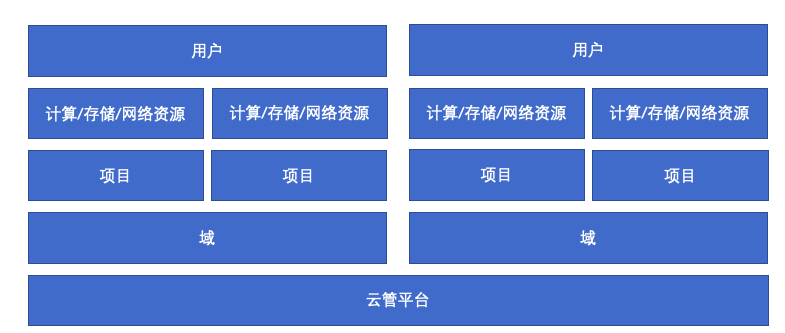
default domain.system project).The OneCloud platform supports integrating multiple identity providers such as LDAP, DingTalk, Feishu, and WeCom, and supports logging in to the OneCloud platform via third-party app QR codes and other methods.
Organization is used to manage domains or projects hierarchically and filter lists by organization tree.
A domain is a logical concept on the cloud management platform based on multi-tenancy. A domain contains a complete, logically autonomous system.
A project owns resources; resources on the OneCloud platform are provided to users by project.
A group is a collection of users.
Users manage and directly use resources.
A role is a collection of policies; the role assigned when a user joins a project determines the user’s permissions in that project.
Policies define operation permissions on platform resources.